
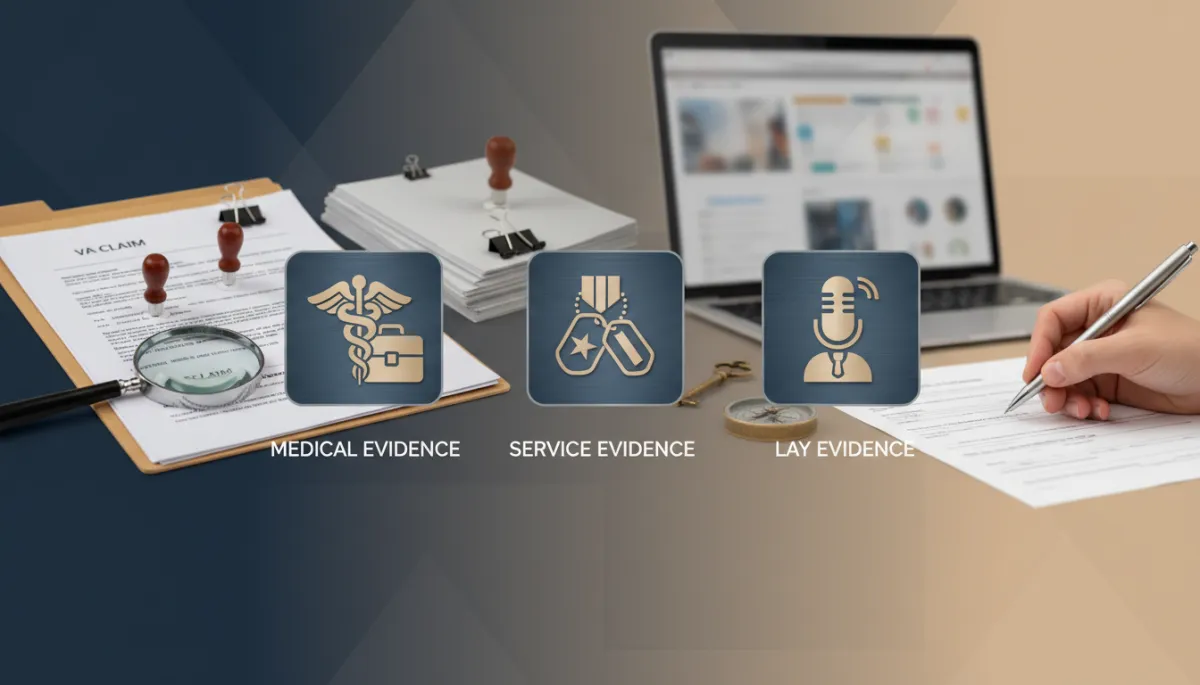
Strengthen Your VA Claim with Key Evidence Types
VA Benefits Guide, Veteran Claims Process, VA Evidence Types
The 3 Types of Evidence the VA Uses (And How to Strengthen Each One)
Understanding how the Department of Veterans Affairs evaluates evidence can be the difference between a denied claim and the benefits you have earned. This VA Benefits Guide explains the three main VA Evidence Types and offers practical, professional strategies for strengthening each one so you can navigate the Veteran Claims Process with greater confidence.
Why Evidence Matters So Much in the Veteran Claims Process
Every VA disability claim, whether for a new condition, an increase, or a secondary disability, is built on one foundation: evidence. The VA is required to decide your claim based on the VA Disability Evidence in your file. If the right information is missing, unclear, or weak, the VA may deny your claim even if your condition is very real and clearly impacts your life. Understanding the three core VA Evidence Types, and how they fit together, is essential to presenting a persuasive case for service connection and the correct rating.
In simple terms, the VA wants to see: what happened in service, what your current disability is, and how the two are connected. Each type of evidence plays a different role in answering those questions. When you know how to strengthen each category, you transform a loose collection of records into a clear, credible narrative that supports your claim.
📌 Key Takeaway: The VA does not grant benefits based on need or fairness alone. It must rely on the evidence you and the VA gather and submit. Strong, organized evidence is your most powerful tool.
The 3 Types of Evidence the VA Uses
While there are many documents and records that can appear in a claims file, they fall into three broad VA Evidence Types that the VA relies on most often:
Service records and official documents (what happened during service)
Medical evidence (diagnoses, treatment, and current severity)
Lay evidence (statements from you and others who know you)
Each category serves a distinct purpose in the Veteran Claims Process. The strongest claims typically include all three, working together to tell a consistent story. The following sections break down how to strengthen each one and offer practical Evidence Submission Tips you can apply right away.
Evidence Type 1: Service Records and Official Documents
Service records form the backbone of many VA disability claims. These documents show where you served, what your duties were, and what events or exposures may have occurred. The VA often looks to these records first to confirm that an in-service event, injury, disease, or exposure actually happened.
Common Service-Related VA Disability Evidence
Service Treatment Records (STRs), including sick call notes and hospitalization summaries
Personnel records, including duty assignments, performance evaluations, and disciplinary records that may reference incidents or stressors
Deployment orders and records showing locations, combat service, or hazardous duty pay
Line of Duty determinations and accident reports
Awards and decorations that may indicate combat or specific exposures (for example, Combat Infantryman Badge, Air Medal with “V” device)
How to Strengthen Service Record Evidence
Not every service-connected disability will be clearly documented in your official records, but there are concrete steps you can take to make this category of VA Disability Evidence as strong as possible.
Request and review your records early. Obtain copies of your Service Treatment Records and personnel file. Review them carefully for references to injuries, complaints, or events related to your claim. Knowing what is (and is not) documented helps you decide what additional evidence you need.
Highlight key entries for the VA. When you submit copies, consider including a brief cover letter that cites specific dates, clinics, or entries that relate to your claimed condition. This is a simple but effective Evidence Submission Tip: make it easy for the rater to find what matters most.
Use alternative records when traditional records are missing. If service records are incomplete or lost, you can submit alternative documents, such as unit histories, buddy statements, pay records, or civilian hospital records from the time of service. These can help fill gaps and support your account of in-service events or exposures.
Connect locations and duties to known exposures. For claims related to Agent Orange, burn pits, radiation, or other environmental hazards, documentation showing where and when you served can be critical. Cross-reference your locations with VA-recognized exposure areas and cite those connections in your claim.
💡 Pro Tip: Even if your injury was not fully treated in service, a single note showing you complained of knee pain, back pain, or anxiety can be powerful when paired with strong medical and lay evidence later. Do not overlook brief or seemingly minor entries.
Evidence Type 2: Medical Evidence (VA and Private)
Medical evidence is the core of most VA disability claims. It establishes that you have a current disability, documents its severity over time, and often provides the medical opinions that link your condition to service. This category includes both VA medical records and private treatment records, as well as Compensation & Pension (C&P) examination reports.
Key Types of Medical VA Disability Evidence
VA medical center and clinic records, including problem lists, imaging, and specialty consults
Private physician and specialist records documenting diagnosis, treatment, and prognosis
Mental health treatment notes, psychological testing, and therapy summaries
C&P examination reports ordered by the VA to evaluate your condition and its relationship to service

Close-up of a veteran meeting with a healthcare provider at a VA clinic, both reviewing medical...
Coordinated care between VA and private providers can significantly strengthen medical evidence.
How to Strengthen Your Medical Evidence
Maintain consistent treatment. Gaps in treatment can raise questions about the severity or continuity of your condition. Attend scheduled appointments, follow prescribed treatment plans when possible, and document reasons if you cannot (such as cost, transportation, or worsening symptoms). Consistent records over time are a key part of Strengthening Evidence in this category.
Ensure your diagnosis is clearly documented. For many conditions, especially mental health disorders or complex physical issues, a clear, formal diagnosis from a qualified professional carries substantial weight. If your records are vague, ask your provider to document the specific diagnosis and its basis in the medical record.
Request a detailed medical opinion when appropriate. A well-written medical nexus opinion can be decisive. Ideally, it should:
Review relevant service records and post-service medical history
State whether it is “at least as likely as not” (50% or greater probability) that your condition is related to service
Provide a clear rationale, citing medical literature or clinical experience where possible
Coordinate VA and private records. Do not assume the VA will automatically obtain all private records. Submit release forms or upload records directly through your online VA account. Make sure both VA and private providers have an accurate, up-to-date list of your diagnoses and medications to avoid confusion in the file.
Prepare for your C&P exam. While you should never exaggerate or minimize symptoms, it is important to be ready to discuss your history and current limitations clearly. Before the exam, review your own records, consider how your condition affects daily life and work, and bring a brief list of key points you do not want to forget. This is one of the most practical Evidence Submission Tips for strengthening medical evidence.
📌 Key Takeaway: The VA often relies heavily on medical opinions to decide whether a condition is service connected and how severely it impairs you. High-quality, consistent medical documentation can significantly influence the outcome of your claim.
Evidence Type 3: Lay Evidence and Personal Statements
Lay evidence refers to statements from non-medical professionals—often you, family members, friends, coworkers, or fellow service members—who can describe what they personally observed. While lay evidence cannot diagnose complex medical conditions, it can be extremely powerful in explaining how and when symptoms began, how they have changed over time, and how they affect your daily functioning.
Examples of Lay VA Evidence Types
Your own personal statement describing the onset of your condition, in-service events, and current impact on your life
Buddy statements from fellow service members who witnessed an injury, stressor, or change in your behavior or abilities during service
Statements from spouses, partners, or family members describing how your condition affects your relationships, mood, sleep, or ability to function at home
Letters from supervisors or coworkers explaining how your symptoms limit your work performance, attendance, or safety
How to Strengthen Lay Evidence
Be specific and concrete. Instead of writing, “My back hurts all the time,” describe how far you can walk, how long you can sit or stand, and what tasks you can no longer perform without assistance. Specific examples make your statements more credible and useful in the Veteran Claims Process.
Focus on what you personally observed. Lay witnesses should avoid medical conclusions (for example, “He has PTSD”) and instead describe behaviors and changes they have seen (for example, “After returning from deployment, he started having frequent nightmares and avoided crowded places”).
Organize statements chronologically. When possible, explain how symptoms began, how they progressed, and how they now affect daily functioning. A clear timeline helps the VA connect the dots between service and current disability, supporting your other VA Disability Evidence.
Use VA forms when available. The VA provides specific forms, such as VA Form 21-4138 (Statement in Support of Claim) and other specialized statement forms. Using these can help ensure your lay evidence is properly associated with your claim and clearly labeled in the file.
Align lay and medical evidence. Your personal statements and buddy letters should not conflict with the medical records. Before submitting, review both types of evidence to ensure they tell a consistent story. If there are differences, explain them (for example, you underreported symptoms in earlier medical visits due to stigma or fear of career impact).
💡 Pro Tip: Lay evidence can be especially important for conditions that are underreported or stigmatized, such as mental health disorders, military sexual trauma, or chronic pain. Thoughtful, detailed statements can fill in the gaps left by sparse service or medical records.
How the Three VA Evidence Types Work Together
The most persuasive claims rarely rely on a single type of evidence. Instead, they weave together service records, medical documentation, and lay statements into a coherent narrative. In practice, this means:
Service records show an in-service event, injury, or exposure.
Medical evidence confirms a current diagnosis and explains how it is related to that in-service event.
Lay evidence fills in the day-to-day impact, continuity of symptoms, and real-world limitations you experience.
When these three VA Evidence Types are consistent and mutually reinforcing, they give the VA a clear, credible basis to grant service connection and assign an appropriate rating. If one category is weak or missing, the others become even more important. This is why Strengthening Evidence across all three categories is such a critical part of an effective VA Benefits Guide and strategy.
Practical Evidence Submission Tips for Veterans
Submitting strong evidence is not only about what you provide, but how you provide it. The following Evidence Submission Tips can help you present your VA Disability Evidence in a way that is organized, clear, and easier for VA decision-makers to evaluate.
File a Fully Developed Claim when possible. The Fully Developed Claim (FDC) program encourages you to submit all available evidence upfront. While not required, it can sometimes lead to faster decisions and ensures the VA reviews a complete package from the start of the Veteran Claims Process.
Label and organize your submissions. When uploading documents online or mailing them, include a brief cover page identifying what you are sending (for example, “Private orthopedist records: 2018–2023” or “Buddy statement from Sgt. J. Smith regarding 2010 IED incident”). Clear labeling reduces the risk that key documents will be overlooked or misfiled.
Submit evidence promptly and keep copies. Retain copies of everything you send and note the date of submission. If you upload through your VA online account, confirm that documents appear in your claim file. If you mail evidence, use tracking when possible. This simple step can save significant time and frustration if questions arise later.
Respond to VA requests for information. If the VA sends a letter asking for additional evidence or clarification, respond as thoroughly and promptly as you can. If you need more time, communicate that. Ignoring these requests can lead to avoidable denials or delays in your VA Benefits Guide journey.
Consider professional assistance. Accredited Veterans Service Officers (VSOs), claims agents, and attorneys can help you identify missing evidence, frame your arguments, and avoid common pitfalls. While not required, professional guidance can be especially valuable for complex claims or appeals.
Common Evidence Mistakes to Avoid
Even strong claims can be weakened by avoidable errors in how evidence is gathered or presented. Being aware of these pitfalls helps you protect the integrity of your VA Disability Evidence and maintain credibility throughout the Veteran Claims Process.
Relying solely on VA to gather all records. While the VA has a duty to assist, it may not automatically obtain every private record or specialized report. Taking an active role in collecting and submitting evidence helps ensure nothing critical is missing.
Submitting vague or inconsistent statements. Inconsistent lay evidence or medical histories can raise doubts about credibility. Review your submissions for clarity and consistency, and explain any changes in your account over time.
Overlooking secondary conditions. Many disabilities cause or aggravate other conditions—for example, a knee injury leading to hip or back problems, or chronic pain contributing to depression. Failing to document and claim these secondary conditions can leave significant benefits on the table. Strengthening Evidence for secondary claims often requires targeted medical opinions and detailed lay descriptions.
Assuming the VA “knows” your story. Even if you have been in the VA system for years, the rater deciding your claim only sees what is in the file. Do not rely on assumptions. Spell out key facts, timelines, and impacts clearly in your evidence and statements.
Using This VA Benefits Guide to Plan Your Next Steps
Understanding the three primary VA Evidence Types and how to strengthen each one gives you a practical roadmap for improving your chances of a successful claim. Whether you are filing for the first time, seeking an increased rating, or appealing a denial, you can use the following checklist to guide your next steps:
Review your service records. Identify entries that support your claimed condition, and note any gaps that may need to be addressed with lay evidence or alternative documents.
Gather and update medical records. Ensure your current diagnoses and treatment history are thoroughly documented, and consider requesting a focused nexus opinion when appropriate.
Draft clear, detailed lay statements. Write your own statement and invite those who know you well to provide specific examples of how your condition affects your daily life and work.
Organize your Evidence Submission. Label documents, use appropriate VA forms, and submit everything through reliable channels, keeping copies for your records.
Seek guidance if needed. If you feel overwhelmed, consider consulting an accredited VSO, agent, or attorney who can help you apply these Strengthening Evidence strategies to your unique situation.
Conclusion: Building a Strong, Credible VA Claim
Securing the VA disability benefits you have earned is not simply a matter of submitting a form and waiting. It requires thoughtful preparation, careful documentation, and a clear understanding of how the VA evaluates evidence. By focusing on the three primary VA Evidence Types—service records, medical evidence, and lay statements—and applying the Strengthening Evidence strategies outlined in this VA Benefits Guide, you place yourself in the strongest possible position within the Veteran Claims Process.
Remember that you are not alone in this process. Many veterans have walked this path before you, and there are resources, advocates, and professionals ready to assist. Your service created a record; your current health tells a story; and the people around you see the daily impact. When you bring all three together through well-prepared VA Disability Evidence, you give the VA what it needs to recognize your sacrifices and provide the support you deserve.
Approach your claim with the same professionalism and attention to detail you brought to your service. Organize your records, clarify your statements, and submit evidence that is complete, consistent, and compelling. Doing so will not guarantee a particular outcome, but it will ensure that your voice is clearly heard and that your case is presented at its strongest when the VA makes its decision.
Need help strengthening your evidence or planning your next steps? Visit www.valorhealth.net to explore resources and support tailored to veterans and their families.