
VA Claim Denied? Explore Your 3 Best Options
VA Claim Options, Claim Denial, Supplemental Claim, HLR Process, Appeal Process, Veteran Benefits
VA Claim Denied? Your 3 Best Options (Supplemental, HLR, Appeal)
A denied VA claim is not the end of your fight for Veteran Benefits—it’s the beginning of your next move. This guide walks you, step by step, through your three strongest VA Claim Options: filing a Supplemental Claim, requesting a Higher-Level Review (HLR), or taking your case to a formal Appeal. You will not be left guessing what to do next.
When Your VA Claim Is Denied, You Have More Power Than You Think
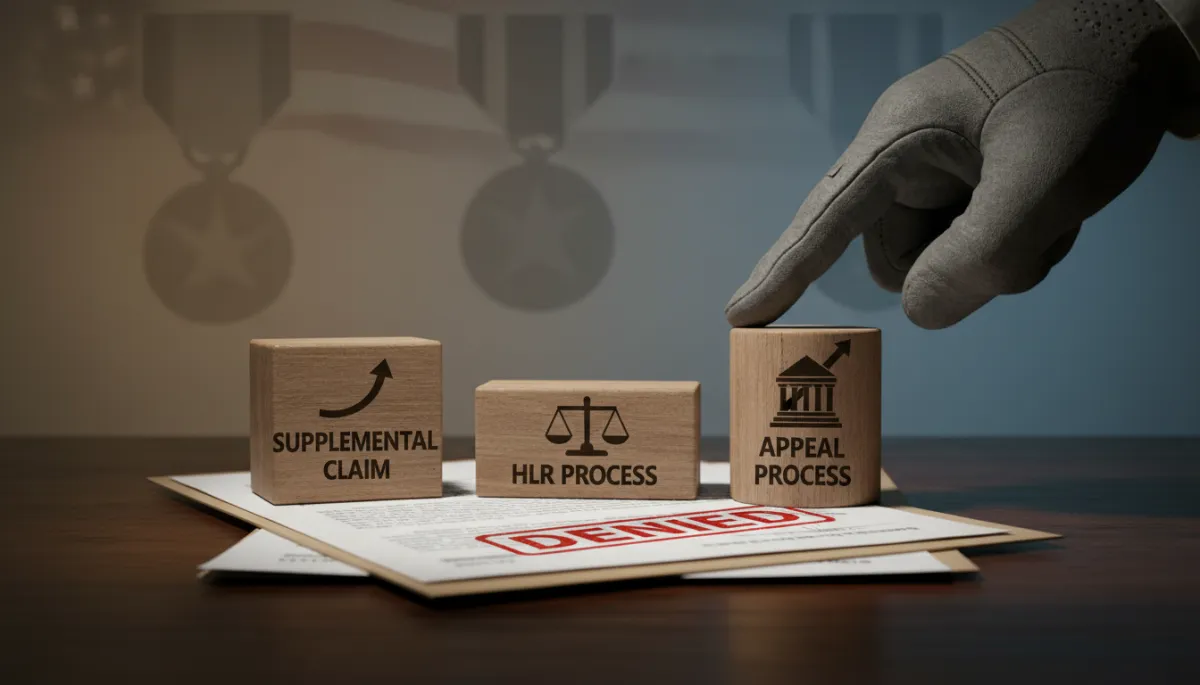
A Claim Denial letter from the VA hits hard. You served. You sacrificed. You did the paperwork. And still, the answer came back: denied or rated far lower than you know your condition deserves. It feels personal—but it’s not the final word. Under the modern VA system, you have three clear, powerful VA Claim Options to push back and fight for the Veteran Benefits you earned: the Supplemental ClaimHLR ProcessAppeal Process
The VA counts on veterans feeling overwhelmed, confused, or simply exhausted. That confusion leads many people to give up. You are not going to be one of them. You are going to understand your options, choose the lane that fits your situation, and respond with a plan—not with frustration.
📌 Key Takeaway: A denial is not a dead end. It’s an invitation to respond—strategically, confidently, and on your terms.
Step One: Read Your VA Decision Like a Strategist, Not a Victim
Before you choose between a Supplemental ClaimHLR ProcessAppeal Process, you need to know exactly why the VA said no—or why they lowballed your rating. That information is sitting in your decision letter, even if it’s buried in confusing language and legal jargon. You are going to mine it for leverage.
Look for the section titled “Reasons for Decision.” This is where the VA tells you, in black and white, what they think is missing or why they don’t agree with you.
Identify whether they questioned service connection, the severity of your condition, or the effective date. Each problem points you toward a different VA Claim Option.
Note any references to “no diagnosis,” “no nexus,” “insufficient evidence,” or “condition improved.” Those phrases tell you exactly what evidence you need to bring to the fight.
💡 Pro Tip: Do not just skim the letter and toss it aside. Highlight every reason for denial. Those reasons are your roadmap to overturning the decision.
Your Three Core VA Claim Options After a Denial
Under the VA’s modern review system (often called AMA—the Appeals Modernization Act), you have three main VA Claim Options after a denial or an unfair rating:
Supplemental Claim – You submit new and relevant evidence and ask the VA to reconsider with that additional information on the table.
Higher-Level Review (HLR Process) – You ask for a more senior VA reviewer to reexamine your existing file for errors, without adding new evidence.
Appeal Process to the Board of Veterans’ Appeals – You take your case to a Veterans Law Judge who can review the evidence, hold a hearing, and issue a formal decision.
These are not random choices. Each path fits a specific situation. If you pick the wrong lane, you can waste months—or years—without moving the needle on your Veteran Benefits. You are going to choose deliberately, based on what your case actually needs.
Option 1: The Supplemental Claim – When You Need More Firepower in Your File
If the VA denied your claim because of missing, weak, or incomplete evidence, the Supplemental Claim lane is your weapon of choice. This option lets you submit new and relevant evidence and forces the VA to take another hard look at your case with that added information. You are not just complaining—you are strengthening your file and demanding a new decision.
What Counts as “New and Relevant” Evidence?
New means the VA did not have it when they made the last decision. If it was already in your file, it does not count as new.
Relevant means it actually helps prove something that matters in your case—service connection, severity, or effective date. Random paperwork won’t cut it. You are targeting the VA’s exact reason for denial.
Examples of strong new and relevant evidence for a Supplemental Claim include:
A new medical nexus opinion from a qualified doctor clearly linking your condition to your service—with “at least as likely as not” language spelled out in bold terms.
Service records or deployment records that the VA previously overlooked, showing exposure, injuries, or events that support your claim.
Private treatment records documenting the true severity of your condition—pain levels, limitations, flare-ups, or mental health symptoms that the VA exam glossed over.
Buddy statements from fellow service members, family, or friends describing how your condition started, how it changed over time, and how it impacts your daily life.

Strong evidence—organized and targeted—turns a weak denial into a winnable claim.
When a Supplemental Claim Is Your Best Move
Choose the Supplemental Claim lane when:
The VA said there was no diagnosis—but you now have clear medical records proving otherwise.
The VA denied service connection—and you can now get a strong nexus letter or service records tying your condition to your time in uniform.
Your rating is too low because the VA underestimated your symptoms—and you can show updated medical evidence or detailed personal statements proving more severe limitations.
💡 Pro Tip: Do not file a Supplemental Claim with the same weak evidence and hope for a different outcome. That is not a strategy; that is wishful thinking. Add real, targeted, new evidence or choose a different lane.
How to File a Supplemental Claim with Intention
You file a Supplemental Claim using VA Form 20-0995. But the form is just paper. What wins your case is the strategy behind what you attach. Here is how to approach it with purpose:
Identify the exact reason the VA denied or lowballed your claim. Target that reason directly with your new evidence.
Collect and organize your new records, statements, and medical opinions. Label them clearly and explain, in writing, how each piece supports your claim.
Keep copies of everything you submit. Treat your file like a mission-critical packet, not a pile of random paperwork.
A well-built Supplemental Claim can flip a denial into an approval and unlock the Veteran Benefits you have been fighting for—monthly compensation, health coverage, and more. When you bring new firepower, you change the entire conversation.
Option 2: The HLR Process – When the Evidence Is There but the VA Got It Wrong
Sometimes your evidence is solid—but the VA still blows the call. Maybe the rater misread your records. Maybe they ignored a key exam. Maybe they misapplied the law or the rating criteria. In those moments, the HLR Process (Higher-Level Review) is your way to say, “Look again—and this time, do it right.”
What Exactly Is Higher-Level Review?
In a Higher-Level Review, a more experienced VA adjudicator reexamines your claim using the same evidence that was in your file at the time of the prior decision. You are not allowed to add new evidence in this lane. Instead, you are arguing that the VA misinterpreted or misapplied the evidence they already had. You are calling for a smarter, more careful review—not a brand-new record dump.
You request HLR using VA Form 20-0996.
You can ask for an informal conference—a phone call where you or your representative can highlight errors and point the reviewer toward key evidence.
💡 Pro Tip: If you know the VA already had enough proof but still denied you, the HLR Process lets you push for a correction without waiting for new medical appointments or chasing new records.
When Higher-Level Review Is Your Smartest Play
Consider the HLR Process when:
The VA ignored a critical medical report that was already in your file, or they misread the findings.
The rating decision clearly misapplied the rating schedule—for example, your symptoms line up with a 50% rating, but they gave you 10% with no explanation.
You believe the VA made a legal or factual error based on the evidence they already had—no new documents needed, just a correct reading of the record.
How to Use the HLR Process to Expose VA Errors
To make the most of Higher-Level Review, you need to do more than just check a box. You need to point the reviewer straight at the VA’s mistakes. That means:
Compare your decision letter to your medical records and C&P exams. Identify where the VA’s explanation clashes with the actual evidence.
Write down specific, concrete errors—missed diagnoses, overlooked symptoms, misquoted exam findings, or misapplied rating criteria.
If you request an informal conference, be prepared. Treat it like a mission briefing: direct, focused, and backed by the record.
The HLR lane is about forcing the VA to respect the evidence that is already there. If your file is strong and the denial is clearly off-base, this option can be a fast, focused way to correct the record and secure the Veteran Benefits you should have received the first time.
Option 3: The Appeal Process – Taking Your Case to a Veterans Law Judge
Sometimes you need a fresh set of eyes outside the regional office altogether. That is where the Appeal Process to the Board of Veterans’ Appeals comes in. Here, a Veterans Law Judge—an actual judge focused on veterans’ law—reviews your case. This is a more formal lane, but it is also a powerful one, especially when your case is complex, legally heavy, or repeatedly mishandled at the lower level.
Your Three Appeal Lanes at the Board
When you appeal to the Board using VA Form 10182, you choose one of three lanes. Each one gives you different tools and timelines:
Direct Review – No new evidence, no hearing. The judge reviews the existing record and the prior decision. This is for cases where the evidence is already strong and you want a legal review, not more development.
Evidence Submission – You can submit new evidence within a limited time window after filing the appeal, but you skip a hearing. This is for veterans who can strengthen their file but do not need live testimony.
Hearing Lane – You request a hearing with a Veterans Law Judge (virtual or in-person) and can submit additional evidence as well. This lane gives you a voice and a chance to tell your story directly.
When the Appeal Process Is Worth the Wait
The Appeal Process can take longer than a Supplemental Claim or HLR, but it packs serious weight. Consider this lane when:
Your case involves complex legal issues, such as secondary service connection, aggravation, or intertwined conditions the VA keeps mishandling.
You have already tried other VA Claim Options without success, and it is clear the problem is deeper than a simple oversight.
You want a judge to look at your entire story, not just a rater skimming a file in a busy office.
Strengthening Your Appeal Like a Professional
A Board appeal is not the place for guesswork. It is where you bring your most organized, most persuasive case. That means:
Building a clear timeline of your condition—onset, treatment, worsening, and impact on work and daily life.
Gathering medical opinions that use the right legal language and directly address the VA’s prior reasons for denial.
Considering representation from a veterans law attorney, accredited agent, or strong VSO who understands Board-level strategy.
The Board is where you fight for the full measure of your Veteran Benefits—not just a quick fix, but a thorough, authoritative decision that can correct years of errors and open the door to back pay and long-term support.
How to Choose Between Supplemental Claim, HLR, and Appeal
You now know the basics of each lane. The real power comes from choosing the right one for your situation. Here is a bold, honest way to decide:
Ask Yourself Three Hard Questions
“Is my evidence actually complete?” If you know something important is missing—a diagnosis, a nexus, proof of severity—lean toward a Supplemental Claim.
“Did the VA ignore or misread the evidence I already gave them?” If yes, and you do not need new documents, the HLR Process can be your fastest correction tool.
“Is this fight bigger than one rater’s mistake?” If your case is legally complex, repeatedly mishandled, or high-stakes, the Appeal Process to the Board may be worth the longer wait.
Mixing and Matching Your VA Claim Options Over Time
The system is not one-and-done. You can use these lanes in combination over time. For example:
Start with a Supplemental Claim to add powerful new evidence. If the VA still gets it wrong, move to the HLR Process or the Appeal Process to challenge their logic.
Use an HLR first if you are confident the evidence is already strong. If the higher-level reviewer still denies you, escalate to the Board for a judge’s review.
📌 Key Takeaway: You are not stuck with just one path. You can move between a Supplemental Claim, the HLR Process, and the Appeal Process as your evidence grows and your strategy evolves.
Protecting Your Effective Date and Your Back Pay
One of the most overlooked parts of fighting a Claim Denial is the effective date—the date from which your benefits are paid. Get this wrong, and you can lose months or even years of back pay. Get it right, and your eventual win can come with a serious financial impact in your favor.
When you respond to a decision within the allowed time frames using a valid review option—Supplemental Claim, HLR Process, or Appeal Process—you often preserve that original effective date. That means if you win later, your Veteran Benefits can be paid retroactively back to when you first filed, not when you finally got it approved. That is a huge difference.
⚠️ Warning: If you miss deadlines or simply file a brand-new claim instead of using the proper review options, you risk resetting your effective date and losing back pay you should have had in your pocket.
Why This Fight Matters: The Real Impact of Veteran Benefits
This is bigger than a form, a file, or a rating code. Your Veteran Benefits can change your daily life:
Monthly disability compensation that helps cover rent, food, and family essentials when your body or mind will not cooperate like it used to.
Access to VA healthcare and treatment that you should not have to fight for—but often must.
Potential education benefits, housing benefits, and survivor benefits that protect not just you, but the people who stand beside you every day.
When the VA gets it wrong, it is not just a paperwork error. It is a direct hit to your stability, your health, and your future. That is exactly why you cannot afford to walk away after a denial. You have tools. You have lanes. You have options. Use them.
Building a Support Team So You Are Not Fighting Alone
You are not required to face the VA alone—and you do not get bonus points for suffering in silence. Smart veterans build a support team to back their VA Claim Options and strengthen their fight against a Claim Denial.
VSOs (Veterans Service Organizations) can help you understand forms, gather evidence, and choose between a Supplemental Claim, HLR, or Appeal at no cost.
Accredited agents and attorneys who focus on veterans’ law can step in when your case gets complicated or when you are heading to the Board of Veterans’ Appeals.
Medical professionals who understand VA standards can write clear, powerful opinions that speak the VA’s language and leave little room for denial.
💡 Pro Tip: Asking for help is not weakness. It is a tactical advantage. The VA system is complex by design. Bring in people who navigate it every day.
Your Next Move: Turn Frustration Into Action
Your claim was denied. That stings. But the story does not stop there unless you let it. You now know your three main VA Claim Options:
The Supplemental Claim route, where you bring in new and relevant evidence and force the VA to reconsider with more complete information.
The HLR Process, where you call out VA errors and demand a senior reviewer give your existing file the serious attention it deserves.
The Appeal Process to the Board, where a Veterans Law Judge can weigh your evidence, your story, and the law itself to issue a binding decision.
You also understand what is at stake: not just numbers on a page, but the Veteran Benefits that keep a roof over your head, treatment within reach, and your family supported. That is worth fighting for—with clarity, with strategy, and with persistence.
So do not let a Claim Denial sit in a drawer and gather dust. Pull it out. Read it. Break it down. Decide whether your next strike is a Supplemental Claim, the HLR Process, or the Appeal Process. Then move. The VA will not hand you what you earned without a fight—but you are more than capable of fighting back, and now you know exactly how.
You showed up for your country. You carried the weight when it counted. Now it is time to make the system show up for you. Pick your lane. Build your case. Push forward until your benefits match your service—no less.
When you are ready for guided support with your next move, visit www.warriorbenefits.com to explore your options and get help taking the next step.