

Why Veterans Struggle With Purpose After Service
Veterans, Mental Health, Finding Purpose, Transition Challenges
Why Veterans Struggle With Purpose After Service (And How to Rebuild It)
Leaving the military can feel like stepping off a moving train. One day you’re surrounded by a clear mission, a tight-knit team, and a structured routine. The next, you’re staring at a blank calendar wondering, “What now?” If you’re a Veteran wrestling with post-service struggles and trying to figure out your next chapter, you’re far from alone—and there is a path forward toward finding purpose again.
Why Purpose Feels So Different After Service
During service, purpose is rarely in question. You wake up knowing exactly why you’re there and what you’re working toward. The mission might change, but the sense of meaning is constant. When that structure disappears, many Veterans experience a kind of emotional whiplash. It’s not just a career change—it’s a full-blown rebuilding of identity.
In uniform, your role is clear: you’re part of something bigger than yourself. After separation, everyday life can feel strangely small. The stakes seem lower, the tasks more routine, and the sense of camaraderie can be hard to find. That gap between “then” and “now” is one of the biggest reasons Veterans struggle with purpose after service—and it’s often at the heart of many transition challenges and mental health concerns.
Common Post-Service Struggles That Undermine Purpose
Every Veteran’s story is different, but there are patterns that show up again and again. Understanding these post-service struggles can help you make sense of what you’re feeling—and remind you that you’re not “broken” or failing. You’re adjusting to a huge life change.
1. Loss of Mission and Clear Direction
In the military, your mission is handed to you. You don’t have to wake up and wonder what matters today—it’s already defined. After service, the freedom to choose your own path can feel overwhelming instead of exciting. Questions like “What should I do?” or “What’s the point?” can show up quietly at first, then grow louder over time if they’re not addressed.
2. Rebuilding Identity Without the Uniform
For years, your answer to “Who are you?” might have started with your rank, your branch, or your role. When that’s gone, it can feel like a piece of you is missing. This rebuilding identity process can be confusing and emotional. You may find yourself wondering, “If I’m not Sergeant, Chief, or Captain anymore, then who am I?”
That shift doesn’t mean your service no longer matters. It means you’re in a new season of life, where your identity expands beyond the uniform. Learning to honor your past while also allowing yourself to grow into new roles is a key part of finding purpose after service.
3. Transition Challenges in Work, School, and Daily Life
Civilian life plays by different rules. Workplaces may seem less direct, communication can feel unclear, and the pace of decision-making might be frustratingly slow. You might miss the structure, the standards, and the sense of accountability. These transition challenges can make you question whether you belong in this new environment at all.
Even small things—like not knowing what to wear, how to talk about your experience in an interview, or how to explain your skills to a civilian employer—can add up. When daily life feels like a series of awkward first-days, it’s easy for your confidence and sense of purpose to take a hit.
4. Mental Health Struggles That Cloud Your Sense of Meaning
Many Veterans carry invisible wounds. PTSD, depression, anxiety, moral injury, and traumatic brain injuries can all affect how you see yourself and the world. When your brain is stuck in survival mode, it’s incredibly hard to think about long-term goals or big-picture purpose. Just getting through the day can feel like a mission of its own.
Mental health challenges are not a sign of weakness—they’re a natural response to intense experiences. But if they’re left unaddressed, they can quietly drain your motivation, energy, and hope. Taking care of your mental health is not separate from finding purpose; it’s a core part of rebuilding it.
5. Shifts in Relationships and Community
In service, your unit can feel like family. You share hardships, jokes, routines, and risks. After separation, that built-in community can vanish overnight. Friends move away, schedules don’t line up, and you might feel like the only one in your neighborhood who “gets it.” That sense of isolation can deepen post-service struggles and make it harder to feel like you matter to anyone outside of your past role.
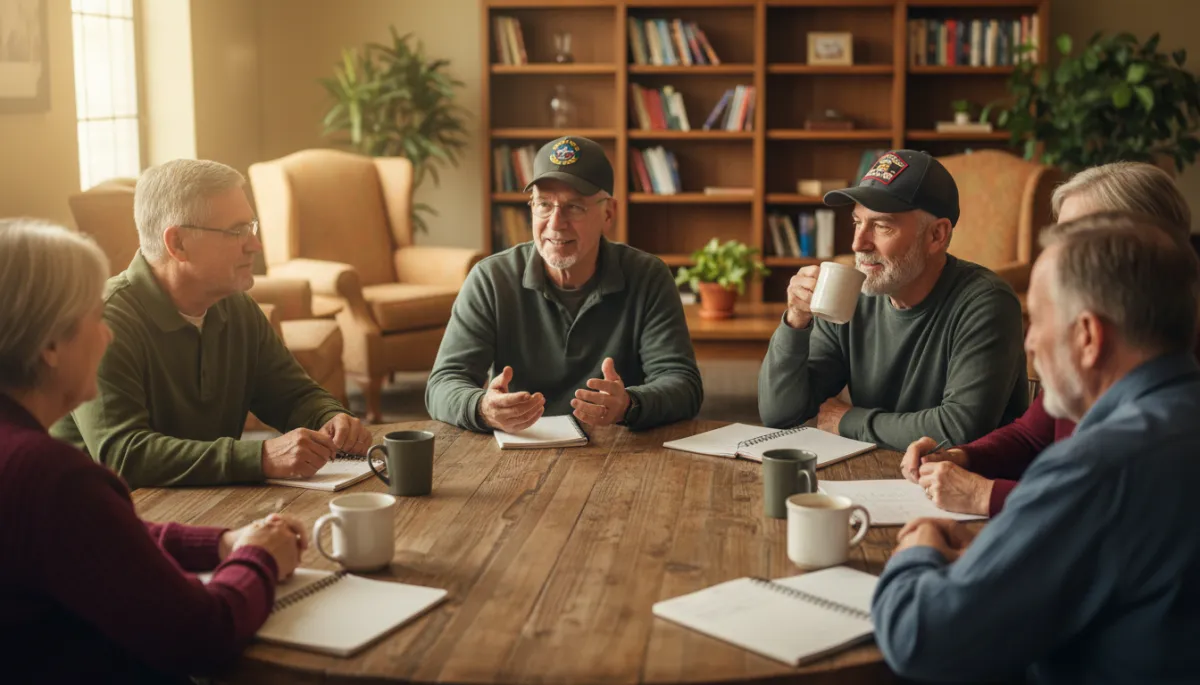
Peer support gives Veterans a safe place to share stories and rebuild connection.
How Mental Health and Purpose Are Deeply Connected
It’s hard to talk about finding purpose without talking about mental health. When you’re carrying trauma, grief, or chronic stress, it can feel like you’re walking through life with a heavy rucksack that no one else can see. You might know, logically, that there are things you care about—but emotionally, you feel numb, disconnected, or constantly on edge.
Mental health care can lighten that load. Therapy, peer support groups, medication, and holistic practices like exercise, mindfulness, or spiritual counseling can all help your brain and body come out of survival mode. When you’re not constantly fighting internal battles, it becomes much easier to notice what gives you energy, what you value, and where you want to invest your time. In other words, caring for your mental health opens the door to purpose, instead of the other way around.
💡 Friendly Reminder: Asking for help is not “being weak.” It’s the same as getting medical care for a broken bone—you’re giving yourself what you need to heal and move forward.
Rebuilding Identity: You Are More Than Your Rank and MOS
One of the most powerful shifts you can make after service is to see yourself as a whole person—not just as your military job title. Yes, your time in uniform is a huge part of your story. But it’s not the only chapter. Rebuilding identity means asking, “Who am I now?” and allowing the answer to grow over time.
Recognizing the Strengths You Still Carry
Even if your daily routine looks nothing like it did in the military, the strengths you developed there are still with you. Discipline, teamwork, resilience, problem-solving under pressure, leadership, and attention to detail are all incredibly valuable in civilian life. The challenge is learning how to translate those strengths into new roles and environments.
For example, maybe you were responsible for logistics, maintenance, or leading a small team. In civilian terms, that could mean you’re skilled in project management, operations, or people leadership. When you start seeing yourself through this wider lens, your options for finding purpose expand dramatically.
Allowing Yourself to Explore New Sides of You
It’s completely okay if your next chapter looks nothing like your last one. Some Veterans find purpose in careers related to their military specialty. Others discover new passions in art, teaching, counseling, entrepreneurship, or community work. Neither path is “more Veteran” than the other. Your worth isn’t measured by how closely your new life matches your old one—it’s measured by how aligned it feels with who you are now.
📌 Key Takeaway: Rebuilding identity isn’t about erasing your service. It’s about adding new layers to who you are, while honoring where you’ve been.
Practical Ways to Start Finding Purpose Again
Purpose doesn’t usually show up as a lightning bolt. More often, it’s something you build slowly, through small choices and experiments. If you’re feeling stuck, here are some friendly, practical steps to help you start rebuilding that sense of meaning—one day at a time.
1. Start With What Matters to You, Not Just What You Can Do
In the military, you’re trained to focus on the mission’s needs. After service, it can feel strange—even selfish—to ask, “What do I care about?” But this question is at the heart of finding purpose. Think about moments in your life, in or out of uniform, when you felt proud, connected, or deeply engaged. What were you doing? Who were you helping? What values were you living out—like loyalty, courage, fairness, or service?
Write down a few of those values and themes. You don’t need a perfect answer. You just need a starting point. These clues can guide you toward work, volunteering, or hobbies that feel meaningful instead of just “filling time.”
2. Take Small, Low-Pressure Steps Instead of Waiting for a Big Calling
It’s easy to feel pressure to find “the one big purpose” that will define your entire life. That pressure can actually keep you stuck. Instead, think in terms of experiments. Try signing up for a short class, volunteering once a week, joining a local Veterans group, or shadowing someone in a career you’re curious about. Each step is data: you learn what energizes you and what doesn’t.
Over time, these small actions add up. You start building a life that feels more aligned with your values, even if you can’t sum it up in a single sentence. Purpose often looks less like a job title and more like a pattern in how you show up for yourself and others.
3. Connect With Other Veterans Who “Get It”
You don’t have to navigate post-service struggles alone. Other Veterans are walking similar paths, and many organizations exist specifically to support you through transition challenges, mental health concerns, and career changes. Joining a peer support group, a local Veterans organization, or an online community can give you a safe place to talk openly, share tips, and remind yourself that your feelings are normal and valid.
💬 Friendly Tip: If big groups feel intimidating, start smaller. Invite one fellow Veteran for coffee or a walk. Sometimes one honest conversation can do more for your sense of purpose than a dozen online searches.
4. Get Curious About New Skills and Careers
Your military experience is a strong foundation, but it doesn’t have to be the limit of what you can do. Many Veterans find renewed purpose by learning something completely new—whether that’s a trade, a degree, or a creative skill. Education benefits, apprenticeships, and Veteran-focused career programs can all help you bridge the gap between where you’ve been and where you want to go next.
If you’re not sure where to start, consider talking with a career counselor who understands military transitions. They can help you translate your experience into civilian language, explore options that align with your values, and create a realistic plan for moving forward at your own pace.
5. Serve in New Ways—Without Burning Yourself Out
Many Veterans feel most alive when they’re helping others. Service doesn’t have to end when you take off the uniform. You might find purpose in mentoring younger Veterans, volunteering with youth, supporting disaster relief efforts, or joining community projects. The key is to serve in ways that respect your current limits and needs, rather than trying to prove anything to yourself or others.
Remember, you’re allowed to rest. You’re allowed to say no. You’re allowed to choose forms of service that nourish you instead of draining you. Your worth isn’t based on how much you sacrifice—it’s based on the simple fact that you are here, and your life matters.
Navigating Transition Challenges With Self-Compassion
Transition out of the military is often described as a “process,” but that word can make it sound cleaner than it feels. In reality, it’s usually messy, non-linear, and full of mixed emotions. You might feel proud one day and lost the next. You might land a job and still feel like you’re on the outside looking in. This doesn’t mean you’re doing it wrong. It means you’re human.
One of the most powerful tools you can bring to this season is self-compassion. That simply means treating yourself with the same kindness you’d offer a fellow Veteran who was going through the same thing. If a friend told you they were struggling with purpose after service, you wouldn’t tell them to “just get over it.” You’d listen, remind them of their strengths, and encourage them to take one step at a time. You deserve that same gentle approach from yourself.
🧭 Gentle Check-In: When you catch yourself thinking, “I should be further along by now,” pause and ask, “Would I say this to a battle buddy?” If not, try a kinder version instead.
When to Reach Out for Extra Support
Feeling unsure about your direction is normal during big life changes. But there are times when reaching out for extra support is especially important. If you notice that post-service struggles are making it hard to function in daily life—like getting out of bed, going to work or school, maintaining relationships, or taking care of basic needs—it may be time to connect with a mental health professional or a trusted support resource for Veterans.
Warning signs can include persistent sadness, feeling numb or hopeless, withdrawing from others, using alcohol or substances to cope, intense anger, or thoughts of self-harm. These experiences are more common than many people realize, and they are treatable. Reaching out for help is a courageous step toward rebuilding purpose, not away from it.
Your Story Isn’t Over: Reframing Purpose After Service
It’s easy to look back on your time in uniform and feel like that was the “peak” of your purpose. But here’s another way to look at it: your service chapter gave you tools, experiences, and perspectives that you now carry into the rest of your life. Those years were not the whole story—they were powerful preparation for everything that comes next.
Finding purpose after service doesn’t mean forgetting what you’ve been through. It means weaving it into a larger narrative where you are still growing, still contributing, and still deeply needed. Whether you’re supporting a family, mentoring others, creating art, building a business, or simply learning how to take better care of yourself—these are all forms of meaningful, important work.
A Friendly Step-By-Step Summary for Rebuilding Purpose
Recognize the loss. It’s okay to grieve the structure, mission, and identity you had in service. Naming that loss is the first step to healing.
Care for your mental health. Whether through therapy, peer support, or healthy routines, tending to your inner world makes purpose easier to see and pursue.
Rebuild identity piece by piece. You are more than your rank or MOS. Explore new roles and interests that feel authentic to who you are now.
Take small, consistent actions. Volunteer, learn, connect, and experiment. Let purpose emerge from what feels meaningful in real life, not just in theory.
Lean on community. Other Veterans, friends, family, and supportive professionals can walk alongside you as you navigate transition challenges.
Practice self-compassion. Talk to yourself like you would to a respected teammate. Progress is rarely a straight line, and that’s okay.
Closing Thoughts: You Still Have a Mission
If you’re a Veteran who feels unmoored, know this: struggling with purpose after service does not mean you’ve lost it forever. It simply means you’re in a season of rebuilding—of identity, of mental health, and of direction. The skills, courage, and resilience that carried you through your time in uniform are still within you, ready to be applied to new missions, big and small.
Your life after service matters deeply—to the people who love you, to the communities you touch, and to the future you’re still creating. Purpose isn’t something you either have or don’t have. It’s something you build, step by step, with the choices you make each day. And you don’t have to build it alone.
So if today feels foggy or directionless, that’s okay. Take one gentle action—reach out to a fellow Veteran, schedule a counseling appointment, explore a new interest, or simply acknowledge to yourself, “I’m in transition, and that’s allowed.” Each of those steps is a quiet but powerful way of saying: “My story isn’t over. I’m still here. I’m still finding my purpose.”